

Soft-pack retractable grandstand seats are primarily used in stadiums, multi-purpose halls, school auditoriums, theaters, lecture halls, convention centers, and cultural and sports centers. Due to the varying needs of different venues, standardized products often fail to meet user requirements. Therefore, we provide customized services, offering one-to-one design and production based on venue dimensions, functional requirements, load-bearing capacity, aesthetic style, and safety regulations. To ensure project safety, compliance, aesthetics, and durability, the entire customization process is highly rigorous, especially for export projects where quality control is paramount.
The success of customizing a soft-pack retractable grandstand seat depends 80% on the completeness and accuracy of the initial information. First, it's crucial to clarify the client's identity, project type, user organization, and construction location to determine if the project is a new construction, renovation of an existing venue, temporary venue, overseas export project, government tender project, or commercial/cultural/sports project. Different projects have different standards, materials, flame retardant ratings, warranty requirements, and installation conditions. For example, overseas projects must comply with local transport dimensions, voltage standards, and flame retardant standards; school projects must meet requirements for child safety, anti-pinch protection, quiet operation, and environmental friendliness.
The core data required for customizing a Soft-pack Retractable Grandstand Seat needs to be provided by the user or measured on-site by our company. This includes the net length, net width, and net height of the installation area, whether it is a concrete floor, tile floor, wooden floor, or sports floor, the load-bearing capacity of the ground, whether it is a sloping ground, the size of the stadium entrance and exit, the width of the passageway, whether there are obstacles such as columns, walls, steps, stages, or displays, whether evacuation routes are reserved in front of and behind the grandstand, and the safety distance. Missing any one of these data may result in the grandstand being unable to unfold or retract, colliding with obstacles, or failing to meet fire safety regulations.
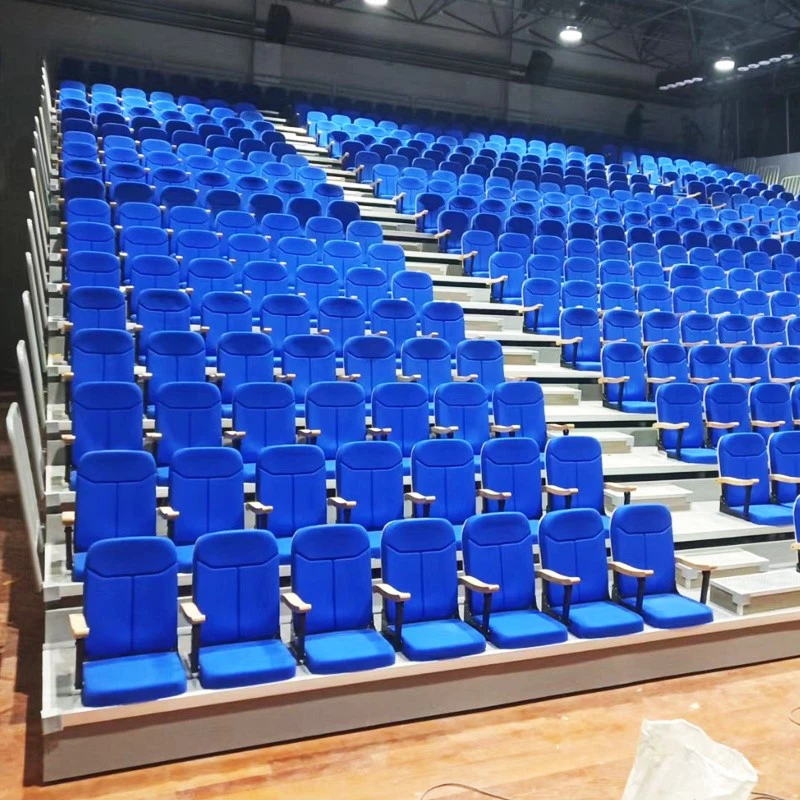
The core selling point of the Soft-pack Retractable Grandstand Seat is its soft-pack design, which is also a major focus for users. Therefore, the selection and design are crucial: Seat upholstery materials: PU leather, flame-retardant fabric, waterproof material, wear-resistant PVC; Upholstery colors: Monochromatic or multi-color combinations; Foam density and thickness: High-resilience flame-retardant foam to ensure no deformation even after prolonged sitting; Seat styles: Straight backrest, curved backrest, one-piece upholstery, separate upholstery; Overall style: Minimalist modern, high-end business, theater style, stadium style.
Before production, the Soft-pack Retractable Grandstand Seat requires a design plan. The technical department will design the layout based on the site data, determining the number of rows, the number of seats per row, the total number of seats, the row spacing, the seat spacing, the step height, the planned evacuation routes, the location of guardrails, the location of motors, the location of control boxes, and ensuring that the space requirements are met in both fully extended and fully retracted states. Based on the layout, a CAD plan is drawn, including the grandstand top view, side view, extended dimensions, retracted dimensions, ground fixing points, foundation requirements, and distance markings to surrounding obstacles.
Once the drawings are confirmed, the Soft-pack Retractable Grandstand Seat can enter the production stage. This involves four production lines operating simultaneously: steel structure, upholstery, transmission mechanism, and electrical control system. Each production stage has different focuses:
Steel structure production: cutting, bending, welding, grinding and rust removal, electrostatic powder coating, high-temperature curing, ensuring structural strength, rust resistance, and uniform appearance;
Upholstery seat production: foam cutting, shaping, fabric cutting, sewing, logo hot stamping, upholstery and inner lining assembly, pressure shaping, flame retardant and environmental testing;
Telescopic mechanism production: guide rails, connecting rods, folding frame processing, force-saving torsion springs, silent bearing installation, anti-pinch structure, and safety limit devices.
Finally, standardized export packaging needs to be considered, which can be negotiated with the user based on the customized quantity.


